


 CLICK TO CALL
Dental Health Blog | Dr. Dan Foresto - Family & Cosmetic Dentistry
Missing One Tooth? Dental Implant Options to Discuss With Your Dentist
August 24, 2026 / Dentistry
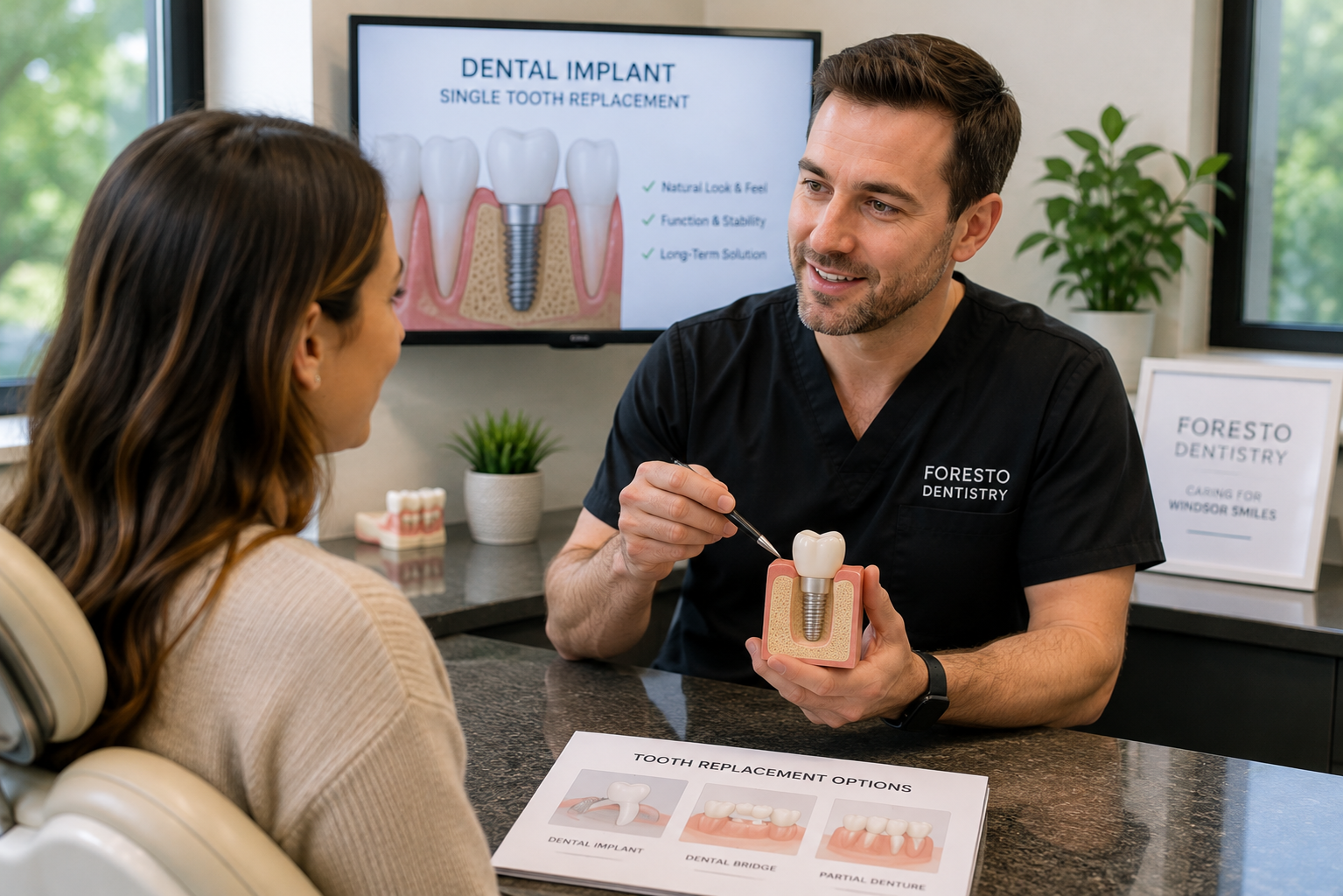
If you're missing one tooth, a single tooth dental implant may be one option to discuss with your dentist. It isn't automatically the right choice for everyone. The condition of the area, your gum health, available bone support, surrounding teeth, overall oral health, and your treatment goals all need to be considered before a recommendation is made.
Replacing one missing tooth can also involve other options, including a dental bridge or a removable partial denture. The right decision depends on your individual circumstances, so an assessment is the best place to start.
For Windsor patients considering their options, dental implants in Windsor can be discussed with the team at Foresto Dentistry as part of a broader conversation about replacing a missing tooth.
What Are Your Options If You Are Missing One Tooth?
A missing tooth doesn't necessarily mean there's only one way to replace it. Depending on the location of the tooth and your oral health, a dentist may discuss a dental implant, bridge, or partial denture.
A dental implant is placed in the jaw to support a replacement tooth. A dental bridge uses neighbouring teeth for support, while a partial denture is a removable option that can replace one or more missing teeth.
The decision isn't simply about choosing the newest or most familiar treatment. Each option has different considerations, including how it interacts with your existing teeth, gums, bite, and daily oral care.
If you'd like to explore the broader considerations involved in replacing missing teeth, Foresto Dentistry also has additional information on the subject.
What Is a Single Tooth Dental Implant?
A single tooth dental implant is a tooth replacement option designed to replace one missing tooth.
Unlike a traditional bridge, an implant is supported by a dental implant placed in the jaw rather than relying on neighbouring teeth for support. Once the area has been assessed and treatment is planned, the implant can support a replacement tooth designed to fill the space.
The important distinction is that an implant isn't simply a replacement tooth that sits on top of the gums. The implant component is placed within the jaw, where it serves as the foundation for the replacement.
Because treatment involves the jaw, gums, surrounding teeth, and bite, an assessment is necessary before determining whether a single tooth dental implant is appropriate.
When Might a Single Tooth Dental Implant Be Discussed?
A dentist may discuss a single tooth dental implant when a patient wants to replace one missing tooth and the surrounding oral conditions are suitable for that type of treatment.
Several factors can influence the discussion.
The health of your gums matters because healthy supporting tissues are an important part of maintaining oral health around a replacement tooth.
The amount and condition of available bone in the area may also need to be assessed. Bone provides support for the implant, so your dentist needs to evaluate the site rather than assuming an implant will be suitable simply because one tooth is missing.
The neighbouring teeth and your bite are considered as well. Their position and condition can affect which replacement options make sense for your situation.
Your general oral health and treatment goals are also part of the conversation. If there are other dental concerns that need attention, your dentist may take those into account when discussing tooth replacement.
What Are the Benefits and Limits of a Single Tooth Implant?
A single tooth implant can offer a way to replace an individual missing tooth without using a removable appliance. Because the implant is designed to support the replacement tooth from within the jaw, it differs from a bridge or partial denture in how the replacement is supported.
For some patients, that approach may be appealing. It can provide a fixed replacement option and allows the missing tooth to be addressed without simply leaving the space empty.
There are limitations to consider, too. Implant treatment involves a surgical procedure and requires appropriate healing and ongoing oral care. Not every patient or every missing-tooth situation is suitable for an implant.
There are also alternatives. A bridge or removable partial denture may be discussed depending on your oral health, the condition of the surrounding teeth, and your preferences.
The goal isn't to choose an implant simply because it's an implant. A good treatment discussion should consider the advantages, limitations, risks, maintenance requirements, and alternatives that apply to you.
What a Dentist Needs to Check Before Recommending an Implant
An implant assessment involves more than looking at the empty space where the tooth used to be.
Your dentist may evaluate:
- Gum health and the condition of the tissues surrounding the area
- The amount and condition of bone available at the site
- The health of neighbouring teeth
- Your bite and how the teeth come together
- Your overall oral health
- Your oral hygiene
- Relevant medical history
- Your goals and expectations for replacing the missing tooth
Diagnostic imaging may also be recommended when it is needed to evaluate structures that cannot be fully assessed during a visual examination.
These details help your dentist determine which options are worth discussing. They also give you an opportunity to ask questions before making a decision.
Questions to Ask Before Replacing One Missing Tooth
If you're considering tooth replacement, you don't need to arrive at your appointment knowing which treatment you want. A consultation is a chance to understand your choices.
Here are a few useful questions to bring with you:
- What options are available for replacing my missing tooth?
- Is a single tooth dental implant appropriate for my situation?
- How does an implant compare with a bridge in my case?
- Would a removable option be reasonable?
- Is there a reason to address the missing tooth sooner rather than later?
- What would the treatment involve?
- What kind of maintenance would each option require?
- What are the potential risks and limitations?
- How would my surrounding teeth and gums affect the decision?
- Are there circumstances that would make another option more appropriate?
The answers will be specific to your mouth and your dental history. That's why an examination is more useful than trying to choose a replacement option based on general information alone.
Frequently Asked Questions About Single Tooth Dental Implants in Windsor
Is a single tooth dental implant right for everyone?
No. A single tooth dental implant may be an option for some people, but suitability depends on factors such as gum health, bone support, surrounding teeth, oral health, medical history, and treatment goals. A dentist needs to assess these factors before making a recommendation.
What happens if I do not replace one missing tooth?
The effects of leaving a missing tooth can vary depending on the location of the tooth, your bite, and your overall dental health. A dentist can explain the considerations specific to your situation and whether replacing the tooth should be discussed.
Can a dental bridge replace one missing tooth?
Yes. A dental bridge can be used to replace a missing tooth in some situations. Unlike an implant, a bridge relies on neighbouring teeth for support. Your dentist can compare the available options based on the condition of your teeth and surrounding tissues.
Can a partial denture replace one missing tooth?
A removable partial denture may be an option for replacing one or more missing teeth. Foresto Dentistry provides information about dentures as one of the tooth replacement options that may be discussed.
How do I know which tooth replacement option fits my situation?
Start with a dental assessment. Your dentist can examine the missing-tooth area, surrounding teeth, gums, bite, and overall oral health before discussing the options that may be appropriate. You can then weigh the benefits, limitations, maintenance, and other considerations of each choice.
Talk to Foresto Dentistry About Replacing One Missing Tooth
Losing one tooth can leave you wondering what to do next, but you don't have to decide on a replacement option before speaking with a dentist.
A single tooth dental implant may be worth discussing, but a bridge, partial denture, or another approach could also be considered depending on your individual circumstances. An assessment gives you the opportunity to understand what's happening in your mouth and make a decision with the relevant information in front of you.
If you're a Windsor patient with a missing tooth and want to discuss your options, contact Foresto Dentistry to arrange an assessment and talk through the possibilities for replacing your missing tooth.